Nepal's Cybersecurity Crisis Is Real
Nepal's digital landscape is growing rapidly and so are the threats targeting it.
Consider these numbers
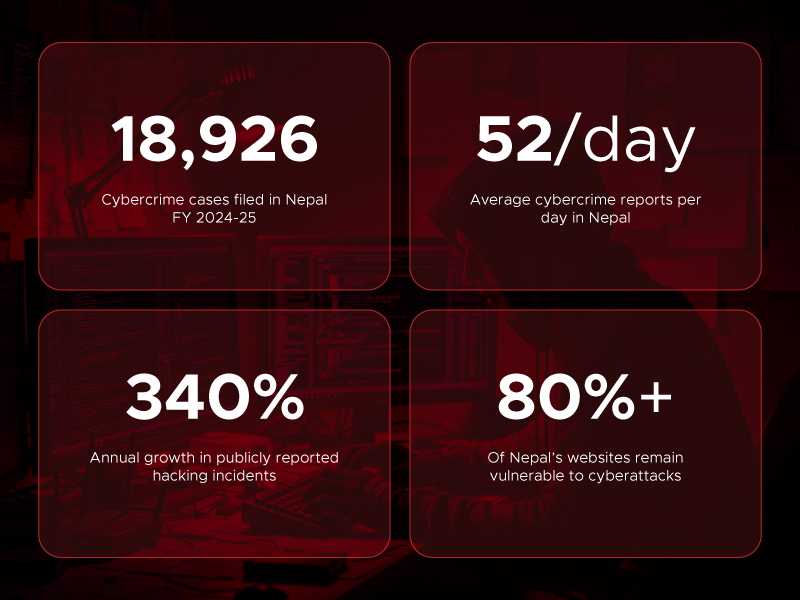
The challenge for every Nepali business today is no longer ‘Will we be attacked?’ but ‘Are we ready when we are?’ This is exactly where the knowledge of Red Team (Offensive) cybersecurity becomes critical.
In this blog, inRED Labs explains Red Team concepts in detail, what they are, how they work, and how a business can use it to develop a strong security posture.
What Is a Red Team? (Offensive Security)
A Red Team models the tactics, techniques, and procedures (TTPs) of real world attackers. Instead of waiting for attackers to identify the vulnerabilities, Red Team experts seek out the systems, networks, and people to identify vulnerabilities before attackers do.

What Red Teams Do?
Penetration Testing (Pen Testing): Simulate attacks on web apps, networks, and APIs to identify exploitable vulnerabilities.
Social Engineering & Phishing Simulations: Test whether employees would fall for targeted phishing emails or impersonation attacks.
Vulnerability Assessment (VAPT): A systematic scan and evaluation of your entire attack surface systems, endpoints, code, and configurations.
Red Team Operations: Full scope, covert adversary simulations often unannounced to test your detection and response capabilities under realistic conditions.
Physical Security Testing: Assessing whether unauthorized individuals can gain physical access to servers, server rooms, or restricted premises.
Real Example in Nepal: In 2024, the F1Soft/eSewa breach resulted in the theft of NPR 34.2 million from Nepal's leading digital payment platform. A rigorous Red Team engagement prior to the incident could have identified the exploited vulnerabilities API weaknesses and insufficient authentication controls before attackers did.
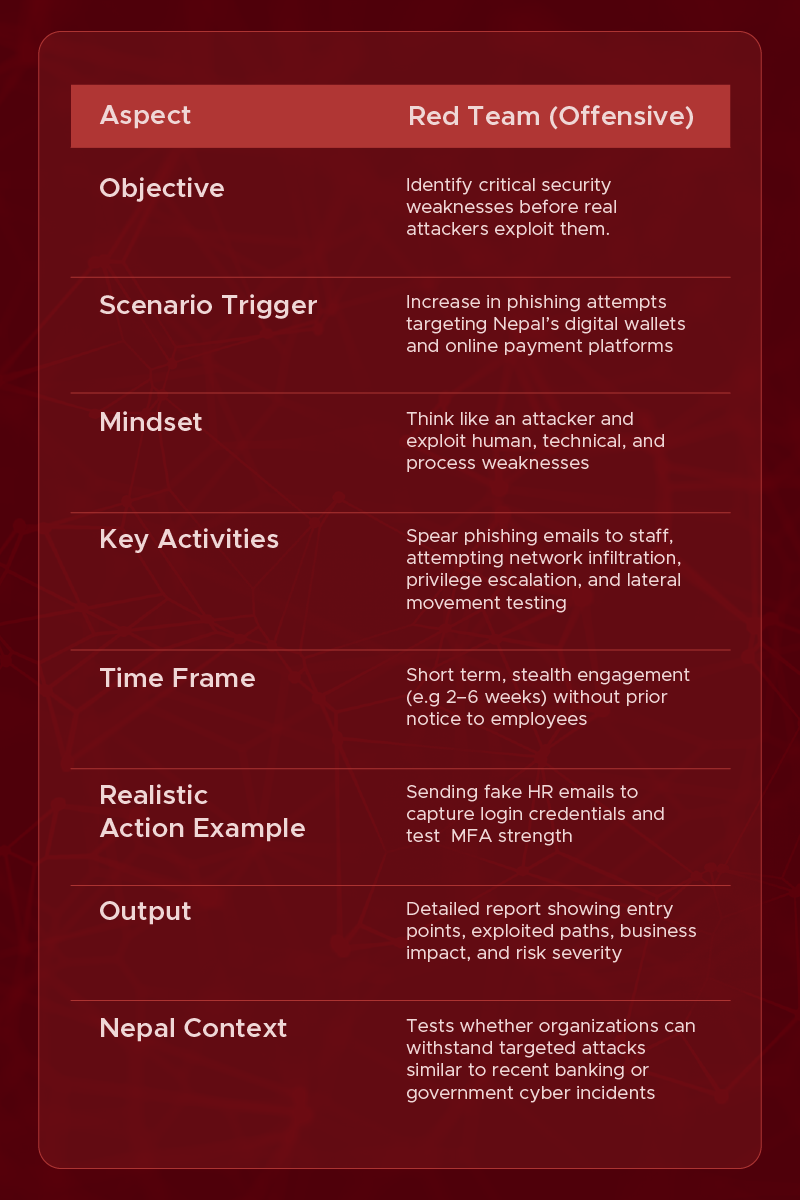
Red Team Aspects
Do You Need a Red Team?
If we focus purely on the Red Team perspective the answer depends on your organization’s risk level and security maturity.
Start With the Red Team If...
You never had a professional security assessment done on your systems.
You are at a high risk of banking, fintech, healthcare, government, or e-commerce.
You have recently deployed new digital infrastructure or applications.
You suspect unusual activity such as slow systems, unexpected logins, or missing data.
Why This Matters for Nepali Organizations Right Now?
The current state of cybersecurity in Nepal in 2025 is at a critical juncture. There has been an unprecedented increase of more than 10,850% in cybercrime complaints from 2018 to 2025, but the Nepal Police Cyber Bureau has only limited trained IT professionals to handle thousands of complex cases annually.
This situation poses a problem for organizations, as they cannot rely entirely on law enforcement for their security. The responsibility falls on businesses themselves to build proactive, layered security.
Key threats facing Nepali organizations today include:
With over 16.5 million Nepalis online and mobile banking transactions having doubled since 2020, the attack surface for Nepali organizations has never been larger. The question is not whether your organization will face a threat, it is whether you will be ready.
How inRED Labs Can Help Your Organization?
At inRED Labs, we provide full spectrum offensive cybersecurity services specifically designed for organizations in Nepal and the South Asian market. Our staff of certified security experts combines the mindset of the attacker with the rigor of the defender to safeguard what is most important to your business.
Our Offensive Security Services (Red Team)
Web Application & API Penetration Testing
Network Infrastructure Penetration Testing
Vulnerability Assessment & Penetration Testing (VAPT)
Social Engineering & Phishing Simulation
Red Team Operations (Full Adversary Simulation)
Mobile Application Security Testing

Red Team is more than just theoretical, it is the difference between finding a vulnerability on your terms versus having an attacker find it for you.
For Nepali organizations operating in an increasingly hostile cyber environment, the need to address offensive security is no longer a choice, it is a basic business imperative.
inRED Labs is ready to help you, whether it is a one time penetration test or a complete security transformation.
FAQs
How can an ecommerce business in Nepal prevent payment fraud and website hacking?
Regular security assessments identify weaknesses in checkout systems, admin panels, and hosting environments. Testing helps reduce risks like SQL injection, credential theft, and DDoS attacks before they impact revenue.
Our bank or fintech platform already has IT staff. Why do we need external security testing?
Internal teams manage systems daily, but independent testing reveals blind spots attackers look for; especially in APIs, authentication systems, and payment gateways. External assessments provide an unbiased risk report and clear remediation roadmap.
Is cybersecurity testing necessary for hospitals and healthcare institutions?
Yes, cybersecurity testing is necessary for hospitals and healthcare institutions to protect patient data, prevent attacks, and ensure privacy and safety.
What should government or public sector organizations prioritize in cybersecurity?
Government and public sector organizations should prioritize cybersecurity because they handle sensitive citizen data and critical systems, so breaches can disrupt services, compromise privacy, and threaten national security.
We are an SME in Nepal. Is our business really at risk?
If you use online banking, cloud software, websites, or digital payments, you are exposed. Smaller businesses are often targeted because attackers assume weaker defenses.
When is the right time to conduct a security assessment?
The appropriate moment for carrying out a security assessment is prior to system deployment, post significant upgrades, or on a regular basis to identify weaknesses and stop cyberattacks.
Why choose inRED Labs for Red Team services in Nepal?
inRED Labs uncovers hidden security gaps in systems, networks, and staff, before hackers do. Also, deliver clear, actionable steps to protect businesses and stay ahead of cyber threats.